New 2025-2027 Steering Committee Members Installed

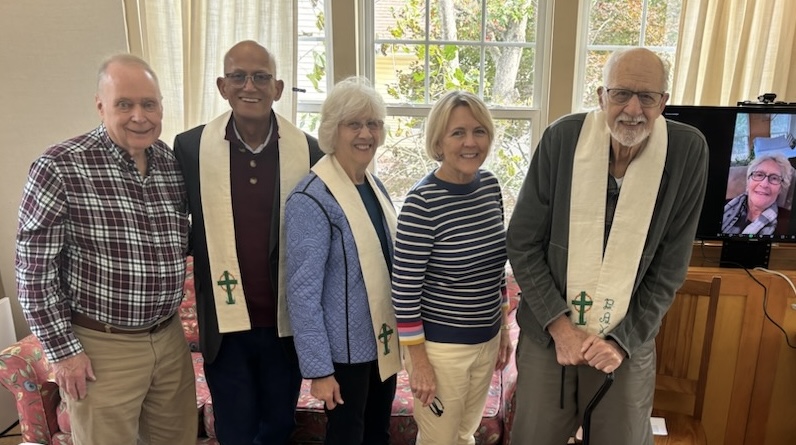
On October 26, 2025, Kathy Brentin and Jesus Rivera were installed as new PAX Steering Committee Members for the next two years. They join Mafalda Marrocco and Ron Novak, who will continue to serve for another year. The new Steering Committee members expressed their thanks to the outgoing members, Mary Blissard and Mike Schaeffer, for their service over the past two years. Mafalda was present for the ceremony via Zoom and is included in the photograph below. During the installation ceremony, both the outgoing and incoming members shared their thoughts about why they accepted the role and what it meant to them. Bravo, all!

Left to Right: Mike Schaeffer, Jesus Rivera, Kathy Brentin, Mary Blissard, Ron Novak, and Mafalda Marrocco

Eulogy for Joe Nangle, OFM

The community of communities who were touched by Joe’s life and ministry gathered at Our Lady Queen of Peace to celebrate his life on Saturday, December 21 – and what a beautiful celebration it was! Our Lady Queen of Peace parish team – everyone! – the Franciscans of Our Lady of Guadalupe Province, Assisi Community and so many other communities that Joe served honored our beloved friend with a beautiful liturgy which is recorded here: https://www.facebook.com/share/v/15RgcckFWg/ or on the parish YouTube page. Over four thousand people have participated in the celebration through the livestream and recording.

Posted below is the lovely eulogy presented by Marie Dennis, PAX Member, cofounder of the Assisi Community, and dear friend of Joe’s. Thank you, Marie!

Joe Nangle, OFM

For the last few weeks of his life, I had the great privilege of reading to Joe the beautiful messages you and so many others sent him. You knew him as loving, joyful, kind, compassionate, wise, humble, prophetic, a peacemaker; dedicated to social justice, to community, to simplicity, to nonviolence; attentive to the signs of the times; a witness to justice. He was all of that and so much more!

I am so aware of who you are and what you represent – a truly beloved community of communities – those of you who are here in person and so many others who are with us virtually:  Joe’s family (he loved you very much), his Franciscan brothers from the Province of Our Lady of Guadalupe and so many other Franciscans, Assisi Community, Our Lady Queen of Peace, the Pax Community, Nova Community, Caldwell Community; Pax Christi USA, Pax Christi International, Franciscan Mission Service and so many more.

I believe that he is with us (as Rahner says, “Those whom death has taken … are not even absent, but living near to us, transfigured…). He is wrapping his arms around us all, telling us that he “loves us to the moon and back.”

Some of you were here a little over a year ago when Pax Christi USA honored Joe as their 2023 Teacher of Peace. I am so grateful that I was asked to introduce him that night so that he could hear at least a portion of what I will say now!

At the core of his being, Joe was a Franciscan Friar. He had a happy childhood in Lexington MA with baseball, hockey and wonderful friends, but once he “put on the brown,” he never looked back. That was central to every other step he took – as priest, pastor and radicalized missioner in Bolivia and Peru; in every organization he served and every ministry he embraced.

As George said so well, Joe was a storyteller. His stories from 15 years in Bolivia and Peru were about a people he loved and what they taught him as a young Franciscan missioner about injustice, about social sin, about the Gospel. Through stories, he shared with all of us his passion for social justice, his deep understanding of liberation theology, his monumental love and respect for people living on the margins of society. Clearly his experience in mission shaped him – his faith, his worldview, his spirituality, his theology, his politics and how he has lived his Franciscan vocation.

He was sent back to the U.S. from Peru by the Church in Latin America transformed at Medellin, by the People of God who themselves were the Church – and by Gustavo Gutierrez, the father of liberation theology – with a clear mission to address the root causes in U.S. foreign policy and U.S. culture of the suffering he had witnessed in Latin America. How well he honored that commitment over the past 50 years – by word and witness, by living simply, by loving widely.

Life in all its beauty, its brokenness, its complexity, its “ordinariness” continued to be the subject of Joe’s stories to the end of his life. They were deep, powerful, radical, funny, poignant. They grounded his theology and his politics and helped to make relevant to all of us both his homilies and his writing.

He challenged his brother Franciscans and the US Catholic Church, the US government, men’s religious communities and formators in women’s religious communities. He challenged all of us – in his homilies, his books and many articles  – to do the social analysis and theological reflection that would help us see and embrace a different, more just way forward. He was never afraid to speak truth to power- and he had ample opportunity to do so!

He challenged our society and the global North whether he was in this country, in Central America, in the Middle East, in the Philippines or elsewhere around the world, and he did so in public, in private, in word and in action. He accompanied public figures in El Salvador and Guatemala when they were threatened by death squads, and Salvadoran refugees when they were ready to return home “en masse” from exile – against the advice of the UN, the Church, the government, the Red Cross. He risked arrest in Washington DC for justice in Central America, in Haiti, in Iraq, on the US Mexico border.

He also served, deeply loved and was loved by immigrants from Latin America living in the U.S. — especially by the Spanish speaking community here at Our Lady Queen of Peace.

You know that Joe was a person of great integrity. He himself faithfully lived what he believed and what he preached – about social justice and voluntary poverty –in Bolivia, in Peru, in Boston taking care of his mother in her last years, in his search for a community committed to justice and simplicity.

He helped imagine and create Assisi Community 38 years ago with a focus on simple living, social justice and witness and he lived in the community since then – with married couples and single lay people, vowed religious, women and men, often children or teenagers. Joe brought all his gifts, his stories and his beautiful spirit to the community every day. At times, as with Sister Dianna Ortiz and a few others, he helped our community heal deep trauma, some of which, like Dianna’s was very public, but for several others was intensely private. Ours is a community of equals and he was always completely at home with that equality – he cooked, cleaned and did other household chores when it was his turn. At the same time, his celebration of the Eucharist for Assisi Community was a unique gift of immense value to all of us. How he loved the Eucharistic prayers focused on nonviolence written by the Association of US Catholic Priests!

And always he was thoroughly pastoral. Joe could give the most radical homilies — thoughtfully, intentionally stirring up “good trouble” — and everyone would applaud! We all loved his weekly reflections published by Pax Christi USA because they are clear and interesting and challenging, but also because they were written in the voice of a Franciscan pastor who clearly loved with tremendous generosity.  

Joe was constantly growing – intellectually and spiritually. In his later years he became more and more a contemplative, treasuring the early morning hours for quiet prayer. He came to appreciate the immense mystery of the cosmos that we are just now beginning see thanks to the Hubble and Webb telescopes. He reflected deeply on Gospel nonviolence and became an enthusiastic supporter and promoter of Pax Christi’s Catholic Nonviolence Initiative. He followed the synodal process carefully and was delighted by a comment by author Austen Ivereigh in The Tablet about how the Amazon Synod impacted the Synod on Synodality (“The Amazon is flowing into the Tiber”).

His memory was amazing. I listened in a completely different way because he proclaimed the Gospel from memory — and am sure you did as well. For a long time my stomach would be in knots as he recited the Gospel, but I don’t think I ever saw him freeze. His memory served him well throughout his life. I watched him in the last few weeks as he remembered every visitor, every person who called or sent a message – not just who you were, but fine details of his interaction with you or your family – all the Baptisms, First Communions, weddings, funerals.

When the pandemic (and aging) began to slow him down – when blessing ashes on Ash Wednesday in front of the White House or walking the Way of the Cross across the city of Washington DC on Good Friday became less possible, he figured out ways to do more of his pastoral work from home – by phoning many of you to see how you were doing or by agreeing to do spiritual direction at home, though he kept up well with Our Lady Queen of Peace and the independent Eucharistic communities he loves.

He always worried that he had not stayed well enough in touch with his family and old friends, but for years he spent Sunday afternoon calling one after another – especially making sure that he contacted loved ones going through hard times.

I am blessed beyond measure to have walked with Joe Nangle for almost 50 years – to have called him my other half, my soul mate – in a completely honest and beautiful relationship that was so intensely focused outward toward a hurting world. He loved the line from Les Miserables:  “to love another person is to see the face of God.” God’s presence in Joe’s life was vivid and visible.  Day by day he showed me by example how to move full of grace toward the end of life without ever pulling away from the challenges and joys of doing God’s work here. And now he has shown me – all of us – how to die. Joseph Nangle, OFM, beloved friend to so many, how well you held God’s people in your heart!

“Blessed are those who hunger and thirst for righteousness …“  Blessed are you, Joseph Nangle OFM, Presente!

-Marie Dennis, December 21, 2024
Donations in Joe’s Memory

Several people have asked about donations in Joe’s memory “in lieu of flowers.” As you know, Joe’s journey was beautifully multi-directional and most of the organizations with which he was associated over the years are very grateful for financial support, including the new Guadalupe Province of the Friars Minor, Our Lady Queen of Peace parish, Franciscan Mission Service and Pax Christi USA.

But I know he had a special place in his heart for the work of Pax Christi International (PCI) and Pax Christi International’s Catholic Nonviolence Initiative. As a board member of the Pax Christi International Fund for Peace, he has been an energetic fundraiser for PCI and I hope that, among other possibilities, you would consider a donation to Pax Christi International in his memory at www.paxchristifund.org

Marie Dennis, Dec 18, 2024

Father Joe Nangle, OFM – Presenté!!

Our dear Joe died this morning. He was exactly where he wanted to be – at home in Assisi Community and he was at peace knowing that he had done what was his to do. I know he is now resting in the arms of God, but it is hard to imagine a world without Joe Nangle! He loved you all so much. In many ways, PAX was his first home when he arrived from Lima so many years ago and what a gift he has been. Now he is part of the great cloud of witnesses who give us all hope – always a Franciscan brother. Joe Nangle, OFM, Presenté!!

Joe’s funeral will be on Saturday, December 21 at noon at Our Lady Queen of Peace in Arlington, Virginia. Viewing will be at 11:00 am and his funeral will be live streamed.

In peace,

Marie Dennis, December 14, 2024

Homily for Vincent’s Memorial Liturgy – Fr. Ken Himes, OFM

Daniel 12:2-3
2 Timothy 4:1-8
John 19:16b-17;23-24;28-30

This morning, the Word of God is addressed to us who have gathered here and who remember Vincent, as the friars knew him, or Uncle Harry, as his family did.
We’ve just heard a short segment of Passion story of Jesus. In the gospel story of Jesus there is a significant contrast between the first part – the active life and ministry of Jesus and then the latter part, when the Passion of Jesus begins. In the first part of Jesus’ life, we see how active he is. He is the subject of the verbs, the doer of the action. Jesus calls, Jesus teaches, Jesus heals, Jesus ministers, Jesus serves, Jesus forgives, Jesus preaches, Jesus blesses. Jesus is the active one and the verbs are active verbs.
But once the Passion starts and the countdown to his death begins, the verbs regarding Jesus are now in the passive voice. Jesus is no longer the subject of the verbs, the doer of the action. Jesus is now the object of the verbs, the one to whom the action is done. Jesus is led away. Jesus is sentenced. Jesus is handed over to the soldiers. Jesus undergoes suffering at the hands of others. Jesus is stripped and nailed to the cross. The Gospel description of the Passion of Jesus brings this out so clearly and powerfully. He is physically beaten down and he no longer has the energy or the capability to do what he actively did. Jesus is laid on the bed of suffering, his cross, on which he finally dies.
The verbs in the gospel show the once active Jesus – is now the passive one, weak and vulnerable. In this way, Jesus enters into an even deeper solidarity with those who are poor and oppressed, the weak and vulnerable, those subject to pain and death. And here we must remember something important in the life of Jesus and how he brings about salvation. Jesus brings about redemption not just when he is active, in the first phase of his life. In fact, Jesus brings about redemption, particularly in the latter phase of his life – his Passion and death.
And what I’ve just described about Jesus is what happens to each one of us as we grow old, get sick and move towards death. In our earlier years, we are active, we are able, we are in control, we can do and achieve a lot. But as we grow older, as we become frail, we find that we cannot do the things we once used to do, especially when we are sick and dying. The doctors and nurses and aides care for us and do things for us. Our friends and family hold us close to their hearts.
How do we respond to this decline? As disciples of Jesus, we are called to be his followers not only in the active phase of our life, but we are followers of Jesus even when we have been rendered old and feeble, sick and dying. Even in our frailty and brokenness, God is working out our salvation. It is one thing to proclaim God’s love from the pulpit, it is another to proclaim the love of God in the throes of death from your sick bed. And those of us who were graced to spend time with Vincent in his last weeks and days were given a glimpse of that. Throughout the final phase of his life, Vince continued to witness to faith, and hope, and love by showing that even dying, however painful, can be an experience of God’s presence.
In our lives, what do we seek? What do we dare to hope for? A life of success or quick wealth or notable achievement? There are no promises of these to be found in our faith. A life without suffering? The reality of pain and grief are all too evident to hope for that. Perhaps a life without death? The loss of Vincent is a stark reminder of death. What then can we hope for? According to St. Paul, in the second reading we heard this morning, one thing only: that God will be faithful to those who are faithful to the Lord. That is the great hope: God’s love is faithful. When other things fail – God’s love remains. Not even death is more powerful than God’s fidelity to those he loves.
Vincent’s death is not the end of God’s love for we can rightly hope that the experience of death has ushered Vince into a whole new way of knowing God’s presence. We can hope that Vincent knows a life with God that we can neither imagine nor explain. That is our hope today – Uncle Harry lives now in the presence of God. As Paul expresses it, having fought the good fight and run the race, and having kept faith, God has prepared a crown for all who have looked to him.
Years ago, when Vincent was active in the leadership of the Association of Theological Schools, he was the first Catholic to serve as president of that group, he was part of a team on an accreditation visit to a school run by the Quakers. He was quite taken by the people he met on his visit and was fascinated by their approach to church and community. He told me about two roles that Quakers held up as central to being church, being faithful to the church’s mission. The first was the keeper of the vision, a trusted and admired person in the group was charged with the ministry of standing up in the community and reminding its members whenever they began to lose sight of the gospel message. When people got caught up in ego trips, or self-pity, or anxiety and worry about their lives, or lost hope for the future – whatever took people’s eyes away from the prize – it was the role of the keeper of the vision to remind the community of who they were and to what they were committed: the gospel of their Lord Jesus.
Vincent was a keeper of the vision for many of us. As an administrator in our Franciscan fraternity who served for eighteen years as a member of the Provincial Leadership, he articulated the vision of a renewed church that had been promoted at Vatican II and that gave life and energy to his fellow friars. As a preacher in many local communities, including St. Elizabeth Ann Seton in Crofton, MD, the NOVA community in Arlington, VA, and the Pax Community in McLean, VA, Vincent persistently proclaimed the gospel’s vision, whether it was convenient or inconvenient.
Vincent was not only a preacher for the contemporary church, he was an educator for the future church. My early experience of Vincent was as my teacher in ecclesiology back in the fall of 1973; but my foremost experience of Vincent was not as a classroom teacher but as an educator who led the way in theological education for more than two decades as President at the Washington Theological Union. Vincent put up with hardship in that role but he fulfilled his ministry through administration of an institution that formed thousands of men and women who went on to serve in church ministry, both ordained and lay. Vincent helped to shape what ministry in the Catholic church looked like in the decades after Vatican II. He was truly a keeper of the vision.
There is a second role in the Quaker church that Vincent also spoke of with appreciation and that was, the keeper of the joy. It is the task of that person to remind the community of the hope that it shares, reminding one’s fellow believers not to lose sight of the deep-down joy in life that comes from knowing one is right with God and our brothers and sisters.
I lived in community with Vincent for 28 years; I lived under the same roof with Vincent longer than I have lived with any other person in my life. I can say with confidence that he was a keeper of the joy. I do not refer just to his wit and delight in a bon mot or funny anecdote, but more to his serenity amid hard times, his perseverance in climbing up a steep path to attain his goal, his refusal to become negative or carping when confronted with failure. Vincent was persistent; he stayed the course when others might give up. He was not immune to anger or frustration, but those times would pass as he would turn his mind to the work that needed to be done and he would set about doing it. But as a keeper of the joy, Vincent did not just settle for being dogged in his work. He believed in the value, the dignity, the pleasure, of good work and he sought to do it well. His joy came from being of use to others, of being able to assist those who needed a hand or a word of assurance or a bit of guidance.
Throughout his life, Vincent was a keeper of the vision and keeper of the joy; he served his God both in active ministry and, more recently, in illness and suffering. He has indeed fought the good fight and run the good race, and we now pray that he comes into the loving embrace of God. That is our hope for Uncle Harry – that he is with Christ, and Christ is God, and God is love through and through.

Steering Committee (2025-2026)

The Steering Committee (SC) meets monthly. Please contact a SC meeting if you have suggestions or questions. Meeting minutes (beginning February 2024) are now posted on the PAX website at “Recent Steering Committee Minutes”: https://paxcommunity.org/archives/steering-committee-history/.

  • Mafalda Marrocco (703-628-9363), mafaldam@aol.com, serving through Oct. 2026
  • Peter Hendricks (415-509-7376), pshendricks@gmail.com, serving through Oct. 2026
  • Kathy Brentin (301-540-3416), rebkeb@verizon.net, serving through Oct. 2027
  • Jesus Rivera (443-977-0986), jesus@fiercehearts.com, serving through Oct. 2027

Father Vince Cushing, OFM

After a lingering illness, our dear Father Vincent Cushing passed peacefully on November 14, 2024. His heart quietly surrendered, resisting the efforts of a CPR team, after receiving his Church’s blessing from a brother friar. 

For most of PAX’s 55 years, Vince would frequently reminded us of his favorite expression which he embraced in so many ways: “I’m a child of the Holy Ghost…on the road to glory.” Father Vince was firmly rooted in the Church he passionately loved; but so unflinchingly honest in describing a Church seemingly resistant to embrace the sunlight and branches of Vatican II. 

PAX was present with Vince on his very last day.  The day before he died, after an extended visit, our Myrtle Hendricks and Vince’s dear friend Ellie Levine stood on either side of him, placing their hands on his shoulders as Myrtle assured Vince that God was with him and prayed that he have peace and comfort on his final journey home.

Fr. Vince’s memorial service will likely be held Saturday, November 23rd at St. Camillus Church, 1600 St. Camillus Drive, Silver Spring, MD 20903. There will be a wake at 12:00 noon with the memorial service beginning at 1:00 pm. Vince requested a closed casket. An email will be sent on the PAX listserv if there are any changes regarding the wake and service. 

And this note from Fr. John Vitko 

It was and is my blessing to know Fr. Vincent — an amazing Christian and a wonderful man. His earthly presence will be missed greatly — but his heavenly presence and prayers will be with PAX and all of us forever. I/we will pray for him in my personal prayers and in the Church’s prayers for the next 40 days as is our tradition. May his and our loving Lord grant him rest in a place of brightness, a place of refreshment, a place of repose from where all sickness, sorrow and sighing have fled away and MAY HIS MEMORY BE ETERNAL! 

With all my sympathy, love, and prayers, 

Fr. John 

”Dying to Vote” Viewing and Discussion

Our September 28 liturgy was followed by a viewing of Loki Mulholland’s powerful documentary “Dying to Vote.” The documentary, which is 26 minutes long, will only be available to us for this single viewing. This is  because it is being offered to local PBS stations so Loki asked that we not show it at other times.

The subject matter is contained in the title. Many have suffered and died fighting for the right to vote. Much voter suppression, of course, has been and continues to be based in racism. Today, we see a resurgence in voter intimidation and threats to voters and election workers. We also see overt racism in the treatment of Kamala Harrison, the Haitians in Ohio, and many others. 

At the end of the film, Sally will facilitate a question-and-answer period involving Loki and the community.

This should be powerful education event, particularly in the current political climate. 

Peace. 

-Sally and Stephanie

What is the Future of our IEC Communities? – August 25, 2024 – Joint Hybrid Liturgy with the Nova Community

Discussion with NOVA: What is the future of our IEC communities? 

When I reached out to Gloria (Mog) to gather here, we decided to take this opportunity to talk about how NOVA and PAX have concerns for their communities as we look ahead to the next 5 to 10 years. 

Today we appreciate that our time is short but this can be a start to addressing the concerns and needs as IECs (Intentional Eucharistic Communities) that serve this region. Questions we’d like to address in the comments from you all are: 

  • How can our communities keep doing what we are doing as time goes on? 
  • What is required to continue to make a difference moving forward? 
  • Who do we need to connect with to support our efforts? New members? More priests? Other IECs? 

As you can imagine, this is a limited address of a number of issues, but we will do our best to get as much input as possible. 

Comments: paraphrased from notes taken 

Stephanie: I believe that technology has enabled us to redefine what “community” means. We are now able to be far more inclusive, as Jesus taught, not excluding some because of geography, physical conditions, or other factors. Those of us who moved to other states and countries after joining PAX are able to maintain our spiritual connections. Perhaps more moving, we are able to worship with community members in hospital beds, rehab facilities and even hospice – praying with them instead of only for them. That is powerful. 

Dianne (NOVA): We’re also able to worship with community members who are traveling and on vacation. We’ve been able to grow to 75-80 members thanks to Zoom. 

Charlie: PAX usually has about 24 people attending in person on 2nd & 4th hybrid Sundays, and 45 connections on Zoom-only 1st & 3rd Sundays. 

Meg (NOVA): This past year we have discussed where we are going (as a community). We have 4 new members over the last 6 months which has been exciting, but what is our future? 

Mary B: Besides our (small) size, we also have concerns about attracting priests to preside with us while acknowledging those who do are also aging. I believe the people in our larger communities are not being served by the traditional church and we need to do more outreach. I know of a former colleague who was told not to attend church because of who he loves. 

Charlie: Advertising has always been a challenge for PAX while living within the Arlington Diocese. 

David (NOVA): I’m concerned about our carbon footprint (when we meet in person) since many of us do not drive electric vehicles. 

Charlie: Another challenge as IECs is celebrating Eucharist on Zoom (virtually). 

Joe: I love the Eucharist but we also live in the 21st century. Right now, the current (church) practice is you must be around the table. 

Charlie: Can we get to heaven without the Eucharist? 

Mary Lou: Today’s theme is Love over Fear. There’s been fear in PAX: we couldn’t do this, we couldn’t do that. What are the fears we have going forward? 

Nancy (NOVA): I fear the Diocese could come down on the priests who celebrate with us, as already happened with Joe. 8/25/2024 PAX Announcements 

John M (NOVA): Some have an image of riding off into the sunset, but there is another vision: we get up with the sunrise and get to work by attracting newer people who can become new leaders. We’ve become less timid in NOVA, but there still is a danger… 

Pat (NOVA): I am a parent of someone with autism; he can’t tolerate the stimulus of our liturgies. My son’s disability makes it extremely difficult for him to be in group situations. He is stressed when touched by others, hearing many voices around him, etc. How do we reach out to others who need a different environment? 

Rose (NOVA): I am now the second oldest person in NOVA. I love Zoom, it’s the only way I can attend now. At the same time, I attended Holy Thursday services in person and it was wonderful. Regarding reducing our carbon footprint, maybe we can carpool. 

Amanda: My husband Mike and I are responsible for PAX’s children’s ministry. We have no ministry now. We do not attract families or young people without families. When we meet in person only twice a month, and we all are as gray-haired as I am, we aren’t going to attract any families. We need to look at our purpose in gathering, our mission. Are we meeting just to serve each other? We seem to be doing that with compassion, in person and remotely. But aren’t we supposed to look toward serving those around us, our communities, near and far? How do we reach them when our energy is focused inward? 

Unity – July 14, 2024 – Charles Hookey

Today’s lesson, from the letter of Paul to the community at Ephesus, is one of unity. Paul emphasizes the favor and obligation God – through Jesus Christ – has placed on those of us who dwell on the earth.

We are a people blessed with love, not only for the glory of God’s grace, but also for each other: the second Commandment. So, if we love one another, unity would seem to be a natural consequence. However, God also bestowed upon us, uniquely, the gift (maybe the challenge!) of free will. But then, there is the additional gift from God, the Holy Spirit, recognized by the Jewish, Christian, Islamic, and Hindu traditions, which are estimated to account for the spiritual foundation of more than 70% of the world’s people. Further, as followers of the Catholic tradition, we have the Holy Eucharist to nourish us for our journey.

We are, therefore, armed with the tools to get along!

And this is where sometimes we may wonder if God is frustratingly amused or disappointed in us. We created remarkable civilizations and organized our way into and out of countless challenges. How many times have we heard the phrase ‘when disaster struck, the community worked together’? This is where we find hope – and maybe the Holy Spirit -working right in front of our eyes.

Now, we read about natural disasters in Texas, California, and even Vermont, with the remnants of Hurricane Beryl. There’s flooding in Switzerland and South Africa, and China. And we hear of neighbors helping neighbors, often regardless of societal or political borders. But then there are the disasters of our (that is the civilized world’s) own making. In Gaza, Ukraine, Haiti, Myanmar, Afghanistan, Yemen, Sudan, and other places where the folks in charge, or the remnants thereof, have failed their constituents, their congregations, their communities.

And this brings us to our leaders, those we have entrusted, either by acclamation or resignation, to keep us well.  Let’s start with safe and alive.

In Shakespeare’s Twelfth Night it’s written that some people are born great, some achieve greatness, and others have greatness thrust upon them. Stephen Schwartz asks in the opening lines of his musical: “Are people born wicked? Or do they have wickedness thrust upon them?”

These folk that are so blessed, or cursed, tend to become, in minor roles or major positions, leaders. But they were first children, and we believe, as Paul preached to the Ephesians, children of God, holy and blameless. Where and why did the leaders who have betrayed their communities go astray? We may know, or never know, but sadly, their damage is done and, in many instances, irreversible.

However, there will be new leaders, and they are among us now. And the love, or respect, or support, or vote that we can give, or disperse, or share, or cast is what will create a lasting civilization and, with God’s help through the Holy Spirit, nourished for the work by the Eucharist, bring all things together in Christ.